
Guides
You Don't Need Big Traffic to A/B Test. You Need Conversions.
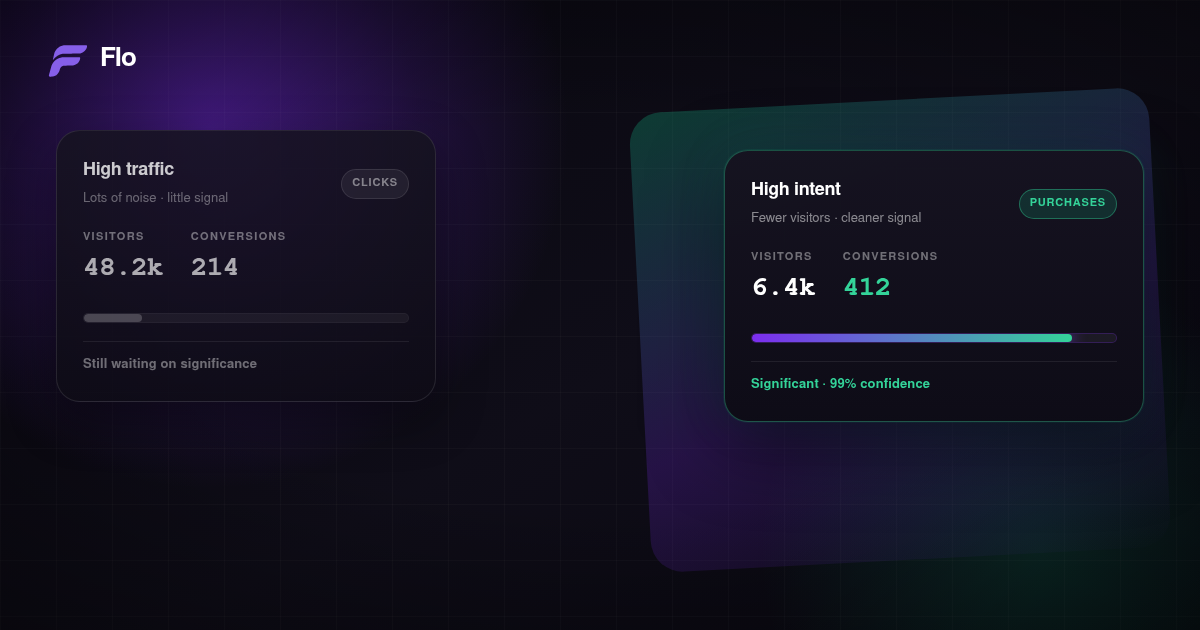
Statistical significance in A/B testing comes from conversions, not visitors. Here's why a smaller, higher-intent audience can often test faster than a much bigger one.
Thomas Bernier · Jul 23, 2026 · 5 min read
Where the "you need more traffic" rule comes from
Most A/B testing tooling built for creators wasn't designed around what actually makes money. It was built around what was already easy to count: clicks, views, thumbnail picks, scroll depth. Cheap to collect, easy to put on a dashboard, easy to look rigorous with in a screenshot.
It's also a weak signal. A click can mean someone found an offer compelling. It can also mean a thumb slipped, someone was bored, or a bot ran the request. Testing on clicks takes real volume to say anything at all, because a lot of what's being counted barely qualifies as a decision. Most creators don't have that kind of traffic to spend answering one question, so they look at a test that hasn't resolved, assume A/B testing isn't for accounts their size, and go back to guessing.
That conclusion isn't wrong because the math was done incorrectly. It's wrong because the test was built on the wrong signal in the first place.
Purchases are a stronger signal than clicks, not just a bigger commitment
A completed purchase means someone looked at a real price, decided it was worth it, and paid. That's a fundamentally cleaner signal than a click, and filtering out the noise is what actually lets a test resolve with less traffic in practice, even when the raw base rate for a purchase is lower than the base rate for a click.
Testing platforms that publish their own statistical methodology describe the same mechanic from a different angle: a binary outcome like a completed purchase reaches a reliable read faster than a continuous metric like revenue, because a converted-or-not signal carries less statistical noise to sort through than one that also has to account for how much someone spent Convert.
The practical version: a creator testing purchases, bookings, or completed checkouts is measuring something with real information in it. A creator testing clicks is mostly measuring curiosity, and curiosity needs a lot more volume before it says anything trustworthy.
Why bigger audiences don't always mean faster answers
A much larger following doesn't automatically mean a faster path to a reliable result. If the overall audience is less engaged, which is common as accounts scale past a certain size, buying intent gets diluted across a lot more people who were never going to purchase regardless of what's being tested. The genuine signal a test needs, real buying intent turning into an actual purchase, can accumulate more slowly than the raw traffic numbers suggest, even with far more total visitors.
Audience size is a vanity ranking. Conversion signal is the ranking that actually determines how fast a test resolves.
What this means in practice
Two shifts make testing accessible regardless of audience size:
- Test on high-intent actions, not clicks.Completed purchases, bookings, and finished checkouts carry real information. Which thumbnail or headline got more taps doesn't answer the only question that actually matters: which version got more people to pay.
- Read results as evidence accumulates, not against a fixed finish line. Instead of freezing a test until an arbitrary visitor count is hit, results can update continuously as evidence comes in, producing an answer whenever confidence is actually high enough, not when a counter finally cooperates.
Why this only works if the platform can see the purchase
There's a real catch: testing on purchase events only works if the platform running the test can actually see the purchase happen. Most creator stacks are stitched together from separate tools: a link page here, a checkout provider there, analytics duct-taped on with tracking pixels and redirects. Every seam is a place data can get lost, sessions can drop, and attribution can break, which is exactly why so many creators end up trying to optimize a funnel they can't fully see.
A storefront with native checkout doesn't have that seam. When the same system shows the offer and processes the purchase, it can follow a visitor from first view to completed transaction inside one continuous dataset. That's what makes purchase-level testing something that works in practice, not just a slide-deck idea.
The actual takeaway
A small audience isn't a disqualifier for A/B testing. It's only a disqualifier for testing on the wrong signal. Purchases, bookings, and completed checkouts carry real information, and any creator getting genuine conversions, regardless of follower count, already has what a meaningful test needs. What's usually missing isn't traffic. It's a storefront built to actually see the conversion happen.
Frequently asked questions
Do I need a large following to run A/B tests?
No. Statistical significance depends on the number of conversions a test collects, not the number of people who saw it. A smaller, high-intent audience can often reach a reliable result faster than a much larger one with a lower conversion rate.
Why do click-based A/B tests need so much traffic?
Clicks are a noisy signal. They can reflect genuine interest, an accidental tap, or automated traffic, so a test built on clicks has to work through a lot of that noise before the result can be trusted.
Why might a bigger audience take longer to reach a significant result?
If a larger audience is less engaged on average, real buying intent gets diluted across more people who were never going to convert, so the genuine signal a test needs can accumulate more slowly than the raw traffic numbers suggest.
What should creators test instead of clicks?
High-intent actions: completed purchases, paid bookings, and finished checkouts. These carry real information about buying decisions, not just curiosity.
What's required to actually run this kind of test?
A platform that can see the full path from a visitor's first view to a completed purchase. That means native checkout, not a stack stitched together from separate tools where data and attribution can break between steps.