Guides
Your Bio Link Is Getting Traffic. Why Isn't It Selling?
Your bio link gets clicks and still doesn't sell. Here's how to convert bio link traffic that's already showing up, and why more content isn't the fix.
Thomas Bernier · Jul 23, 2026 · 8 min read
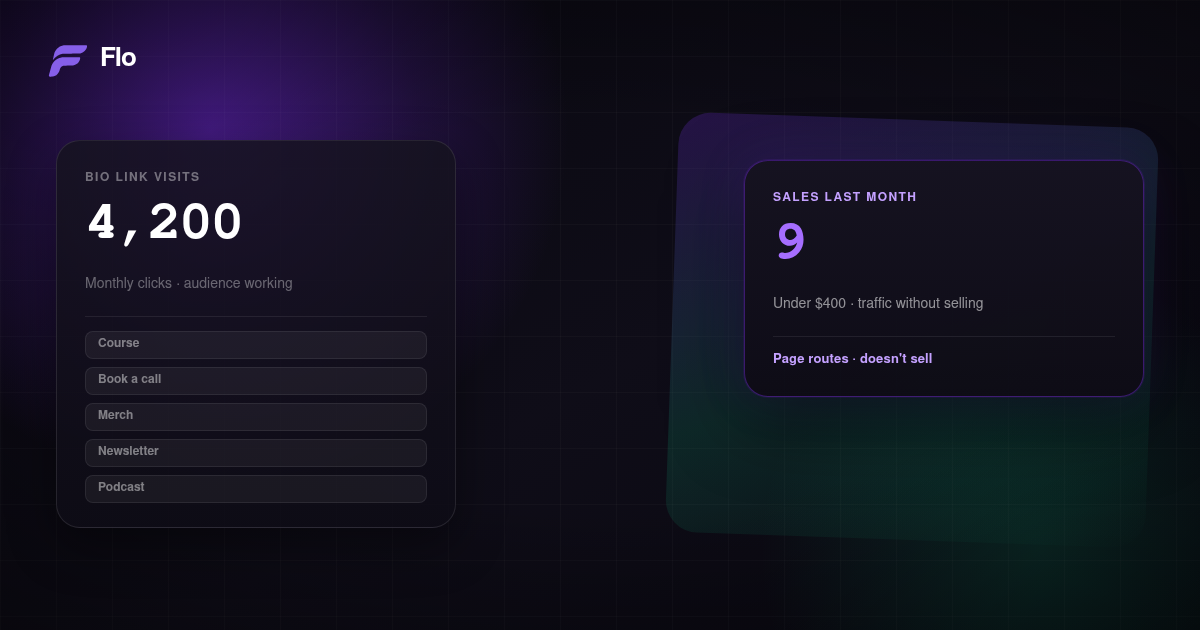
A creator posts consistently, three times a week, sometimes more. The numbers on the content side look good: 38,000 followers, decent engagement, a bio link getting 4,200 visits a month. Everything about the audience side is working.
Then the sales numbers show up. Nine sales last month. A $34 course, a couple of one-off bookings, one merch order. Something under $400 total, against 4,200 people who clicked through wanting to see what's there.
That gap is worth naming precisely. Not "engagement is down." Not "the algorithm changed." Four thousand people showed up and almost none of them bought anything. Traffic isn't the problem. Something else is breaking between the click and the sale, and it's worth finding out exactly what.
Your bio link was designed to route, not to sell
Most bio link pages were never built to sell anything. They were built to solve a much narrower problem: a single platform gives a creator exactly one clickable spot in their profile, and a creator with more than one thing to share needs a way around that limit. Tools like Linktree exist to solve that specific constraint. Give people more places to click. That's a routing problem, not a selling problem, and it's worth being precise about the difference.
A routing tool does exactly what the name implies. It shows a list of links in whatever order they were added, and gets out of the way. The destination does whatever work happens next. There's no hierarchy telling a visitor what matters most. There's no logic deciding which offer to lead with for a first-time visitor versus a returning fan. There's no mechanism anywhere in the page that learns from what visitors actually do. Every link sits at the same visual weight, which means the creator is doing all the strategic thinking themselves, in their head, with nothing to check it against.
If a bio link isn't selling, the reflex is usually to rethink the offer, the price, or the audience. Sometimes that's the real issue. But before touching any of that, it's worth asking a more basic question: is this page even structured to sell anything, or just structured to point somewhere? Figuring out how to monetize a bio link starts with that question, not with a new price or a new offer.
The five reasons bio link traffic doesn't convert
Five specific breakdowns account for most of the gap between bio link traffic and bio link sales.
No clear hierarchy of offers.A page with a course, a coaching call, a merch link, and an email signup treats every one of those as equally important, because nothing on the page says otherwise. A first-time visitor has maybe eight seconds of real attention before deciding whether to explore or leave, and they're being asked to sort through several equally-weighted options with no guidance about which one actually matters. When everything looks equally important, nothing feels urgent enough to act on.
The page doesn't match the traffic source.A creator posting productivity content on TikTok drives traffic that arrived primed for one specific thing, and sends it to a generic page listing a dozen unrelated links. The visitor clicked expecting a continuation of what they just watched. Instead they land somewhere that's about everything the creator has ever offered, with no connection back to what got them there. That context gap does real damage before a single link even gets clicked.
There's no owned relationship being built.Bio link traffic tends to do one of two things: convert immediately, or vanish. There's rarely a middle path, because most pages don't build one. No email capture. No lower-commitment offer for someone who isn't ready to buy today. No reason for a visitor who liked what they saw to come back next week. A visitor who doesn't buy on the first pass is usually gone for good, not because they weren't interested, but because nothing on the page gave them a way to stay connected.
The creator is guessing, not learning.Most creators running a bio link page have no idea which link actually gets clicked most, which offer holds attention longest, or whether reordering the page would change anything at all. Every decision gets made on instinct, because there's no data anywhere in the loop to check that instinct against. Good instincts genuinely help. They just don't compound the way real evidence does.
The checkout experience breaks the world.Even a visitor who's ready to buy right now often has to leave the creator's page entirely to do it. A different platform, a different design, sometimes a separate login before checkout even starts. Every one of those handoffs is a place a ready buyer can second-guess the purchase or just abandon it. The creator's actual world ends right before the moment that matters most, and that gap costs real, avoidable sales.
What a storefront mindset changes
A storefront and a router solve different problems by design. A storefront has a clear front window, something that draws the right visitor in and tells them instantly what this place is for. It has a layout with an actual point of view: one offer featured, others secondary, nothing competing for the same attention. It has a checkout built into the same experience, not a handoff to somewhere else. And it gives a visitor who doesn't buy today a reason to come back, instead of just disappearing.
A routing page has none of that by design, not by mistake. It was never supposed to.
Shifting from a routing mindset to a storefront mindset changes what a creator actually thinks about day to day. Which offer deserves the most prominent spot stops being an afterthought and becomes the first decision. What a first-time visitor needs to see looks different from what a returning fan needs to see, instead of showing everyone the same list. Capturing a visitor's contact information becomes the fallback plan for the majority who don't buy on the first visit, instead of just letting them leave. And the question shifts from "what should I post next" to "what's actually working right now."
That shift in thinking is worth something on its own, before any specific tool enters the picture. This is the basic idea behind what's sometimes called a conversion-first storefront: not a bigger feature list, just a page built to answer what's actually working instead of guessing. A link in bio for creators who sell isn't defined by which platform it's built on. It's defined by whether the page is set up to answer these questions at all.
The one question that changes everything
The creators whose revenue grows fastest usually aren't the ones with the sharpest instincts. They're the ones who stop relying on instinct once there's something better available: evidence.
There's one question almost nobody running a bio link page has ever been able to answer, because they've never had a way to ask it:
Which version of this page actually sells more?
Most creators update their page when something feels off, based on a hunch, with no before-and-after to check it against. No variant to compare. No way to know if last week's change helped, hurt, or did nothing at all.
Here's what that costs in real terms. A creator with 50,000 monthly bio link visits and a $47 product selling to just 1% of that traffic is looking at roughly $23,500 a month. A single percentage point of improvement on that conversion rate, something a real test could actually find, is worth more than most creators will ever get from posting more content.
Most people haven't been asking the wrong question. They've just never had the ability to answer the right one.
This is what Flo was built for
The creators who win the next few years won't be the ones who post the most. They'll be the ones whose pages convert better, and converting better is a skill that can be learned and tested, not a talent some creators are just born with.
That's exactly what a conversion-first storefront is built for: converting followers to customers instead of just routing them somewhere and hoping. The page itself becomes something that can be measured and improved: which offer leads, how it's priced, what the headline says, how checkout actually works. Real experiments, run against real visitors, with real answers instead of guesses.
Flo is built around exactly that idea: one storefront, native checkout, and testing built into the page itself instead of stitched on from somewhere else.
Flo is currently in private beta, opening September 15, 2026. Joining the waitlist is the fastest way to get access as new spots open.
Frequently asked questions
Why isn't my bio link converting even though I get good traffic?
Traffic usually isn't the problem. Most bio link pages were built to route visitors to different links, not to sell anything, so there's no hierarchy of offers, no way to learn what's working, and often a checkout handoff that loses ready buyers before they finish.
What's the difference between a link-in-bio page and a creator storefront?
A link-in-bio page routes visitors to a list of links and gets out of the way. A creator storefront is built to sell: one clear offer in front, native checkout, and a way to test what actually converts instead of guessing.
How do I know if my bio link page is the actual problem?
If a meaningful number of visitors are clicking through but very few are buying, the page itself is worth examining before anything else: offer clarity, checkout friction, and whether every link is competing for the same attention.
What should a creator test first on their storefront?
Which offer leads the page tends to have the biggest effect, followed by pricing and how it's framed. Both are easy to test and directly affect how many visitors actually convert.
Is Flo available right now?
Flo is in private beta, opening September 15, 2026. Joining the waitlist is the fastest way to get access as new spots open.